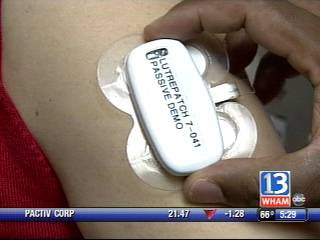
 Researchers are testing a new treatment for fertility – it's a kind of
 pregnancy patch.
Melissa Willmarth describes her 6-week old son Brook as her
little miracle.She said,
It was a long journey... a few years of infertility.
Willmarth credits her
miracleto a team of reproductive health specialists led by Dr. Mike Thomas.
He's part of a national team conducting one of the first trials in the country on a patch to help prepare the body for pregnancy.
It's a patch that pumps hormones into the system every few minutes, primarily for women who have low hormone function, or a condition called polycystic ovary syndrome -- which can lead to irregular cycles,Thomas said.
The patch is being studied in healthy women between the ages of 18 and 38 who want to become pregnant.
There are very few restrictions with the trial, with the exception of not being obese or having a body-mass index of greater than 35.
Thomas's team is comparing the patch to other approved fertility treatments, which means all women who qualify to be part of the study get free fertility care.
Willmarth said,
I couldn't imagine my life without him. He's the best thing that ever happened.
TODAY'S BOOK SUGGESTION:
 Pregnancy After 40: 40 Things No One Told You About Being Pregnant Over 40 (Pregnancy Plan Series)
by Jill Conrad, Pregnancy Support Institute
-- So you're over 40 and you've decided to get pregnant. You are not alone.
A growing number of women are waiting to have a baby until they are over 40.
This book will reveal:
♥ How you can have a healthy baby in your forties (in spite of all the warnings).
♥ What the biggest risks are and what you can do about them (it may not be as bad as you think)
♥ The 3 most important things you can do to have a healthy baby after 40 (you might already be doing some of them)
♥ Why older mothers often make better parents (the surprising reason)
♥ The one thing you should do every night to keep you fertile and able to conceive naturally (it takes 5 minutes)
…and Much More!
So get started and discover how to have the safest pregnancy and the healthiest baby when you are over 40 and pregnant.
 Start reading Pregnancy After 40 on your Kindle in under a minute!
Don't have a Kindle? Get your Kindle here, or download a FREE Kindle Reading App.
 |
| Photo credit: Cari Ellen and Jadyn, by Alan Turkus |
To these, women might add a third: the menopause.
But this year, two separate developments have suggested Franklin was right after all.
In March came a report indicating ovaries contain stem cells which might be prompted to carry on making eggs throughout a woman's adult life.
Then, in October, Belgian doctors reported a woman whose ovaries were damaged by cancer chemotherapy had given birth, possibly owing to a graft of her own preserved ovarian tissue they had transplanted into her body.
Together, these results hinted women might one day be able to delay starting their families until their forties or even beyond.
The scientists working on these projects aim to develop methods to preserve the fertility of women who have been driven through a premature menopause by treatments for diseases such as cancer.
But given many women in industrialized societies want to delay reproduction while they further their careers, such methods are inevitably also going to be seen as tools for healthy women.
Full article: Age is no barrier...
TODAY'S BOOK SUGGESTION:
 Every Drunken Cheerleader: Why Not Me?
by Kristine Ireland Waits
-- If you're eager to have a baby, doesn't the title say enough? Laugh, cry, share, relate - LOVE this book and all it offers to your soul. It's wit, wisdom, and warmth from an author you will quickly see as your sincere fertility-challenged friend.
This information-packed, inspiring story is for women who are struggling with infertility, and for those trying to support them.
Enjoy an easy-reading journey you'll remember throughout life.
Overwhelmed by the idea of dealing with friends' baby showers, insurance, husbands, needles, tears, heartbreak, and surprises?
This book captures it all in a delightful way, packed full of truths and challenges to keep you moving forward.
Indulge in a journey - reading this book will have you throwing your head back in laughter, curling up in the comfort of feeling understood, having raw honesty give you permission to be exactly who you are.
Indulge. You deserve this!
Get one for your best friend, and your mom too.
Paperback: 168 pagesClick to order/for more info: Every Drunken Cheerleader
Start reading Every Drunken Cheerleader on your Kindle in under a minute!Don't have a Kindle? Get your Kindle here, or download a FREE Kindle Reading App.
 |
| Photo credit: Photo courtesy Of Jennalee Ryan - All rights reserved |
A Texas company has started producing batches of ready-made embryos that single women and infertile couples can order after reviewing detailed information about the race, education, appearance, personality and other characteristics of the egg and sperm donors.
We're just trying to help people have babies,said Jennalee Ryan, who arranged for an egg donor to start medical treatments to produce a second batch of embryos this week.
For me, that's what this is all about: helping make babies.
But the embryo brokerage, which calls itself
the world's first human embryo bank,raises alarm among some fertility experts and bioethicists, who say the service marks another disturbing step toward commercialization of human reproduction and
designer babies.
By Rob Stein / Washington Post Staff Writer
Read the full article
TODAY'S BOOK SUGGESTION:
 In Vitro Fertilization: The A.R.T. of Making Babies
( Assisted Reproductive Technology )
by Geoffrey Sher, Virginia Marriage Davis, Jean Stoess
-- This clearly written technical handbook guides couples who are trying to conceive in determining whether they are eligible for in vitro fertilization (IVF), and in selecting the program that will help them achieve the best results.
It describes in detail the anatomy and physiology of conception and the steps required for realizing it in the IVF procedure.
In addition to providing accurate information, the practitioner authors address emotional, financial, physical, and moral-religious issues involved in the decision to conceive with medical assistance.
Despite its experimental reputation and persistent high cost, IVF is an appropriate option for many of the estimated 3.3 million infertile couples in the U.S. today, so this specialized manual speaks to a rather large audience of potential users.
Paperback: 312 pagesClick to order/for more info: In Vitro Fertilization
 Forget all the scare stories about loss of fertility - women who delay having children are on to a good thing, according to a controversial new book by this academic and older mother.
Elizabeth Gregory tells Helena de Bertodano why...
When Elizabeth Gregory gave birth to her first child, Anna, a few weeks before her 40th birthday, she did not think of herself as particularly old to be a first-time mother - even though doctors categorized her as an
elderly primigravida.
In the process of establishing her career, it had not occurred to her to start a family any younger.
I wasn't ready until then,says Gregory, the associate professor of English and director of the Women's Studies Program at the University of Houston, Texas.
Like many women, I was so focused on what I was doing, so absorbed in my career, it wasn't until my late thirties that I started to think about having a family.
Now 50 years old, with two children, one biological, one adopted, she has written a book about the growing tendency to postpone childbirth, Ready: Why Women are Embracing the New Later Motherhood.
The book offers compelling evidence that women who wait to start a family are making a good choice on several levels.
Not only do they have the chance to pursue their own dreams before settling down, Gregory says; once they do start a family they are usually in solid marriages, command higher salaries, and have the clout to shape their careers around their families' needs.
They often make better mothers, claims Gregory.
And the icing on the cake? Women who give birth after 40 even live longer.
Read more
TODAY'S BOOK SUGGESTION:

Ready: Why Women Are Embracing The New Later Motherhood
by Elizabeth Gregory
-- Over the past three decades, skyrocketing numbers of women have chosen to start their families in their late thirties and early forties.
In 2005, ten times as many women had their first child between the ages of 35 and 39 as of 1975, and thirteen times as many had their first between 40 and 44.
Women now have the option to define for themselves when they're ready for a family, rather than sticking to a schedule set by social convention.
As a society, however, we have yet to come to terms with the phenomenon of later motherhood, and women who decide it makes sense for them to delay pregnancy often find themselves confronted with alarmist warnings about the dangers of waiting too long.
In Ready, Elizabeth Gregory tracks the burgeoning trend of new later motherhood and demonstrates that for many women today, waiting for family works best.
She provides compelling evidence of the benefits of having children later -- by birth or by adoption.
Paperback: 336 pagesClick to order/for more info: Ready
Start reading Ready on your Kindle in under a minute!Don't have a Kindle? Get your Kindle here, or download a FREE Kindle Reading App.
 |
| Photo credit: Tea Cup, by Saxon |
METHODS: Women reported on caffeinated beverage consumption and pregnancy status monthly. Odds ratios for becoming pregnant were calculated for both high and moderate vs low consumption.
RESULTS: No significant association was found for any of the caffeinated beverages except tea. Drinking one-half cup or more of tea daily approximately doubled the odds of conception per cycle.
CONCLUSIONS: These data suggest that caffeine may not be the responsible agent for variation in fertility associated with consumption of the beverages examined.
Full text is available as a scanned copy of the original print version. Get a printable copy (PDF file) of the complete article (1.4M), or see the PubMed citation or the full text of some References.
Source: Differences in fertility associated with caffeinated beverage consumption
TODAY'S BOOK SUGGESTION:
 Inconceivable: A Woman's Triumph over Despair and Statistics
by Julia Indichova
-- A memoir of hope for the thousands of women struggling with infertility, from one who beat the odds by simply tuning in to her body and tapping her well of sheer determination.
At a time when more and more women are trying to get pregnant at increasingly advanced ages, fertility specialists and homeopathic researchers boast endless treatment options.
But when Julia Indichova made the rounds of medical doctors and nontraditional healers, she was still unable to conceive a child.
It was only when she forsook their financially and emotionally draining advice, turning inward instead, that she finally met with reproductive success. Inconceivable recounts this journey from hopeless diagnoses to elated motherhood.
Anyone who has faced infertility will relate to Julia's desperate measures: acupuncture, unidentifiable black-and-white pellets, herb soup, foul-smelling fruit, even making love on red sheets.
Five reproductive endocrinologists told her that there was no documented case of anyone in her hormonal condition getting pregnant, forcing her to finally embark on her own intuitive regimen.
After eight caffeine-free, nutrient-rich, yoga-laden months, complemented by visualization exercises, Julia received amazing news; incredibly, she was pregnant.
Nine months later she gave birth to a healthy girl.
Paperback: 208 pagesClick to order/for more info: Inconceivable
Start reading Inconceivable on your Kindle in under a minute! Don't have a Kindle? Get your Kindle here, or download a FREE Kindle Reading App.
 Is the Short Follicular Phase in Older Women Secondary to Advanced or Accelerated Dominant Follicle Development?
Abstract
This study sought to determine whether the shortened follicular phase in ovulatory older women is secondary to advanced (i.e. earlier) or accelerated (i.e. more rapid) folliculogenesis.
Normal ovulatory women, aged 40–45 yr (n = 15) and 20–25 yr (n = 13), underwent daily venipuncture and transvaginal ultrasonography throughout the follicular phase of a spontaneous menstrual cycle (control cycle) and after pituitary down-regulation with a GnRH agonist(study cycle).
As expected, the older subjects in the control cycles demonstrated an elevated day 3 FSH and a shortened follicular phase compared with the younger subjects.
After release from hypothalamic-pituitary-ovarian axis suppression, the early follicular phase FSH peak occurred earlier (6.8 vs. 9.8 d; P greater than 0.01) and was of a greater magnitude (12.1 vs. 6.5 mIU/ml; P greater than 0.01) in the older subjects.
The time from release of suppression until the subsequent LH surge was also shorter (17.5 vs. 20.8 d; P greater than 0.01) in the older group. However, the time from FSH peak to LH surge was similar in the older and younger groups (10.7 vs. 11.0 d; P = 0.74).
Compared with younger women, older subjects had normal follicular phase levels of estradiol and inhibin A and lower levels of inhibin B in both control and study cycles.
We conclude that the shortened follicular phase observed in older ovulatory women is due to earlier dominant follicle selection, independent of hormonal influences from the preceding luteal phase.
Full article: Is the Short Follicular Phase in Older Women Secondary to Advanced or Accelerated Dominant Follicle Development?
TODAY'S BOOK SUGGESTION:
Ready: Why Women Are Embracing The New Later Motherhood
by Elizabeth Gregory
-- Over the past three decades, skyrocketing numbers of women have chosen to start their families in their late thirties and early forties.
In 2005, ten times as many women had their first child between the ages of 35 and 39 as in 1975, and thirteen times as many had their first between 40 and 44.
Women now have the option to define for themselves when they're ready for family, rather than sticking to a schedule set by social convention.
As a society, however, we have yet to come to terms with the phenomenon of later motherhood, and women who decide it makes sense for them to delay pregnancy often find themselves confronted with alarmist warnings about the dangers of waiting too long.
In Ready, Elizabeth Gregory tracks the burgeoning trend of new later motherhood and demonstrates that for many women today, waiting for family works best.
She provides compelling evidence of the benefits of having children later -- by birth or by adoption.
Paperback: 336 pagesClick to order/for more info: Ready - US | CDN | UK
Start reading Ready on your Kindle in under a minute! Don't have a Kindle? Get your Kindle here, or download a FREE Kindle Reading App.
 In her capacity as Director of Human Embryonic Stem Cell Research at Stanford University in California, Dr Renee Reijo Pera is hoping to have viable human sperm in two years, to be followed within five years by human eggs.
The inability to conceive a baby can have many reasons which affect either the female or male or both, that are involved in creating an offspring. Where actual fertility is concerned there are stages throughout a woman and a mans life when their ability to conceive easily occurs. The younger you are when you attempt to have children, the better. With a lot of couples establishing their careers and leaving it ‘till later to start a family, there is bound to be more couples that will require investigating, which leads to fertility treatment.
This research is highly controversial as it uses embryonic stem cells because they provide the best start. Stem cells are part of multicellular organisms that via mitosis can form any cell type. This makes them so versatile when used to grow cells for bone marrow, body organs, repairing nerves or actually any cell in the human body.
There has always been objections to this medical research as cells are harvested from embryos. Dr Reijo Pera obtains the stem cells from the extra eggs that are not needed after IVF treatments. IVF clinics in America make 1 to 1.5 million ova a year and of these, 500,000 are disposed of. Seemingly many are concerned over the 500 being used to enhanced medical procedures and the health of the overall population, instead of the yearly disposal of 500,000 eggs that could be used in lifesaving treatment.
With the ground breaking achievements made by Japanese scientists in making baby mice from sperm and eggs that were grow with stem cells, it has given the US team a boost for their studies to go to the next stage and create a human baby in this way. Being able to produce a viable fertilized egg to be implanted by this method would help so many childless couples. Also the implications as to extending the length of childbearing years of women could be of benefit for those postponing parenthood.
All this said there are factors of opposition to stem cells being used and should women be able to have a baby in later years. So who is going to be brave enough to allow general use of stem cells recovered from embryos and decide how old is too old for a woman to give birth.
Written by Frances Cerulean
Source
Photo credit: Just another nuclear family,
by kga245 on freeimages.com
Some rights reserved
TODAY'S BOOK SUGGESTION:

 Conquering Infertility: Dr. Alice Domar's Mind/Body Guide to Enhancing Fertility and Coping with Infertility
by Alice D. Domar and Alice Lesch Kelly
-- Infertility is a heartbreaking condition that affects nine million American couples each year. It causes tremendous stress, can trigger debilitating sadness and depression, and can tear a marriage to shreds.
In Conquering Infertility, Harvard psychologist Alice Domar — whom Vogue calls the
Fertility Goddess— provides infertile couples with what they need most: stress relief, support, and hope.
Using the innovative mind/body techniques she has perfected at her clinic, Domar helps infertile women not only regain control over their lives but also boost their chances of becoming pregnant.
With Conquering Infertility, women learn how to cope with infertility in a much more positive way and to carve a path toward a rich, full, happy life.
Paperback: 320 pagesClick to order/for more info: Conquering Infertility
Start reading Conquering Infertility on your Kindle in under a minute!Don't have a Kindle? Get your Kindle here, or download a FREE Kindle Reading App.
 |
| Human sperm bound to an egg. (Courtesy of the Talbot Lab at the University of California, Riverside) |
According to Rebecca Burch and Gordon Gallup, researchers at the State University of New York, sex researchers are paying too much attention to sperm and not enough to the makeup of the fluid that carries them.
When Burch and Gallup tested samples of human semen, they found luteinizing hormone and follicle-stimulating hormone, both of which can induce a woman to release eggs earlier than normal. Those hormones were conspicuously scant in semen from primates, like chimpanzees, that advertise their most fertile periods with red, swollen backsides.
Sexual evolution is like an arms race, Burch says. When women evolved concealed ovulation, men most likely developed semen full of hormones to wrest back control of paternity.
Source: DiscoverMagazine.com
TODAY'S BOOK SUGGESTION:

 My Baby Chase: Our Roller Coaster Ride from Infertility to Parenthood
by Gilda Dangot Simpkin
-- This is the heart-wrenching tale of our convoluted 10-year quest to have a family, from the serious, and sometimes hilarious side of fertility treatments, through two harrowing international adoptions. Our journey is filled with so many cliff hangers it reads more like a suspense tale than reality.
As you come along for our wild ride you will be clutching this book praying we don't get derailed again.
Our story of determination and tenacity will give hope to anyone facing a difficult life journey.
Let my story motivate you to attain your dreams!
Paperback: 188 pagesClick to order/for more info: My Baby Chase
Start reading My Baby Chase on your Kindle in under a minute! Don't have a Kindle? Get your Kindle here, or download a FREE Kindle Reading App.
Now this entire foundation of knowledge regarding female egg production and depletion is in question.
A recent paper by Johnson et al., (Nature, March11th 2004, Vol. 428, pp. 145-150) has opened up new doors for a drastic revision of the biological theory behind female egg production, and thus her fertility.
The research comes from the laboratory of Jonathan Tilly, an established and highly respected developmental biologist at Harvard Medical School.
By studying mice, the researchers determined that germ cells persist after birth; and such stem cells give rise to new eggs throughout a mouse's life.
In a remarkably simple experiment, researchers quantified the rate of egg depletion in the mouse ovaries, and determined that the rate should have exhausted the egg supply much earlier. Yet an unidentified replenishment was taking place.
Mice are normally fertile for about a year, but Tilly found that their egg supply would be exhausted in just 2 weeks if it were not somehow being replenished.
Full article: InfertilityDoctor.com
Photo credit: Anna at the Dr, by Sam Pullara, on Flickr
Some rights reserved
TODAY'S BOOK SUGGESTION:

 How to Make Love to a Plastic Cup: A Guy's Guide to the World of Infertility
by Greg Wolfe
-- The man's guide to anything and everything in the infertility universe.
Greg Wolfe went through four cycles of IVF on his rocky journey to fatherhood—and now, with profound sympathy and side-splitting humor, he lays it all out for guys on similar baby-making quests.
How to Make Love to a Plastic Cup is not your typical nuts and bolts (no pun intended) medical guide but a helpful handbook designed specifically with the male partner in mind, with answers to his most pressing questions about the infertility process...
Paperback: 256 pagesClick to order/for more info: How to Make Love to a Plastic Cup
Start reading How to Make Love to a Plastic Cup on your Kindle in under a minute! Don't have a Kindle? Get your Kindle here, or download a FREE Kindle Reading App.

Australian researchers have made a significant discovery that could change the way the female reproductive system is viewed.
Challenging the idea that women have a set number of eggs from birth, scientists from Prince Henry’s Institute as well as Monash’s Department of Anatomy and Cell Biology have found that female mice actually have a renewable supply of eggs in their ovaries.
In their research, investigators found that healthy female mice are able to maintain their overall supply of eggs for longer than previously thought and did not display signs of egg quantity decline.
This suggests that the mice have some way of renewing or replenishing their egg stores, although researchers weren’t exactly sure just how they did this.
While investigators acknowledged that this findings may not hold true in humans, learning just how mice renewed their egg supplies could give scientists an idea of how to help some women with their fertility problems in the future.
Further research is needed in order to understand how the mice maintain their egg supply for so long.
Photo credit: My little mouse friend, by Todd Huffman, on Flickr
Some rights reserved
TODAY'S BOOK SUGGESTION:

 The Brotherhood of Joseph: A Father's Memoir of Infertility and Adoption in the 21st Century
by Brooks Hansen
-- Offering men a chance to be heard and women a rare opportunity to view the struggle with infertility from a male perspective, The Brotherhood of Joseph brings to life the anger, frustration, humor, heartbreak, and sense of helplessness that come to dominate the husband's role.
As his remarkable account reaches its finale in Siberia, however, Hansen's once again becomes the story of a husband and a wife who, even after years of medical frustration and fruitless paperwork, still must take one last risk together and trust in their most basic instincts before their new family can be born.
Start reading The Brotherhood of Joseph on your Kindle in under a minute!Don't have a Kindle? Get your Kindle here, or download a FREE Kindle Reading App.

A protein released by the female body to destroy unfertilized eggs with genetic damage, may help researchers in the quest to treat infertility.
The study, conducted by researchers at the Harvard Medical School, found that a protein, called p63, was responsible for weeding out genetically damaged eggs before they could become fertilized.
This marks the first discovery of a mechanism that controls which eggs are allowed to be fertilized.
In the study, chemotherapy was given to two groups of female mice; one group had p63 removed from their bodies and the other group remained intact. The mice with no p63 had surviving eggs after the course of chemo, while the mice with p63 had none.
Despite the surviving eggs being damaged, the mice were still able to become pregnant. Researchers hope that the discovery can help them to figure out why some women seem to have more eggs than others and give women who have to undergo genetically damaging medical treatment more hope for retaining fertility.
Source: The West Australian
Photo credit: Fertility,
by andidigress/ christian lopez, on Flickr
Some rights reserved
TODAY'S BOOK SUGGESTION:

 Baby Next Time
by Nicole Klieff
-- Based on a true-life account of a woman's discovery of infertility at the age of 35.
This is a compelling roller-coaster insight to the world of IVF exposing treatments and emotions over a nine year span.
Written with humor on such a dark and taboo subject of pregnancy loss and infertility this honest account is directed to the many across the world in a similar predicament.
The book is written in the hope that people will pursue to seek out the reasons for the most common complaint of "unexplained infertility".
Paperback: 140 pagesClick to order/for more info: Baby Next Time
 New research explores the intimate cellular relationship between mother and baby
University of Birmingham scientists have discovered that one of the body’s key immune cells remains active against the fetus during pregnancy, a finding that offers fresh understanding of the complex relationship between the mother and baby during pregnancy and offers insights to the potential causes of miscarriage and stillbirth among women.
In a study published in the Journal of Immunology today (Sunday July 15) Dr David Lissauer and colleagues in the School of Clinical and Experimental Medicine and the School of Cancer Sciences used new techniques to detect a type of T-cells known as CD8 that were directed against the fetus during pregnancy and not deleted by the body, as previously thought.
In normal healthy pregnant women, further mechanisms must exist to prevent these cells from harming the developing baby. But this work indicates that in some women, where these protective mechanisms aren’t working, the CD8 T cells are circulating in the mother’s body, ready to potentially cause problems.
CD8 T cells are best known for their role recognizing and attacking foreign organisms to protect the body from infection or causing the rejection of transplanted organs.
‘This is a scientific observation that is important in understanding the complex relationship between mother and fetus,’ says Dr Lissauer. ‘There may be some women in whom these cells are causing problems.
‘We now recognize that fetal cells and material crosses into the mother’s circulation during pregnancy and our work shows that this is sufficient to trigger the mother’s immune system to produce T cells directed against the baby. Of course, in most women mechanisms exist to protect the baby from these cells but we now need to find out what is going wrong in women who experience problems during pregnancy, like recurrent miscarriage.’
The team is collaborating with the PROMISE clinical trial being co-ordinated by the University of Birmingham, which is exploring progesterone as a potential treatment for recurrent miscarriage.
The team concludes: ‘Our observations indicate that the study of adaptive T-cell immune responses against the fetus should be an important area of future obstetric investigations.’
###
For more information please contact Jenni Ameghino, University of Birmingham, 0121 415 8134 07768924156.
Fetal-Specific CD8+ Cytotoxic T Cell Responses Develop during Normal Human Pregnancy and Exhibit Broad Functional Capacity. Journal of Immunology.
Photo credit: vierdrie
Some rights reserved
TODAY'S BOOK SUGGESTION:

 Green Fertility: Nature's Secrets For Making Babies: A Powerful Proven Plan To Help You Get Pregnant Fast and Have a Healthy Baby
by Niels H. Lauersen and Colette Bouchez
-- Renowned fertility expert Dr. Niels Lauersen and women's natural wellness expert Colette Bouchez combine the best of nature's secrets with all that Eastern and Western medicine have to offer, in an easy, inexpensive plan to help you get pregnant fast and have super healthy babies!
Based on scientific research and tested on thousands of couples, this unique natural approach to conception is designed to uncover what's keeping you from getting pregnant and help you maximize your fertility and have healthier babies - even if you have PCOS, Endometriosis or you are diagnosed with unexplained infertility!
Paperback: 502 pagesClick to order/for more info: Green Fertility
Start reading Green Fertility on your Kindle in under a minute!Don't have a Kindle? Get your Kindle here, or download a FREE Kindle Reading App.
Popular Posts
-
 Menopause is the time in a woman's life when her reproductive system shuts down and her reproducing days are over... or are they? For s...
 -
 Found this post by Ally (Ocelot Cub) on FertilityFriends.co.uk : Ally wrote: I have collected a number of success stories from ladies w...
 -
 A Zen thought ... A true expert is not the one with the most knowledge, but one who causes the most others to have knowledge. Questions, ...
 -
 If you are a smoker and are thinking of becoming pregnant, the first step you must take is to stop smoking. If you're like most smokers,...
 -
 Trying to Get Pregnant Naturally? You’re Not Alone. If you’ve been hoping, praying, and timing everything just right —and it still hasn’t h...
 -
 This plan can help many over 40 women: 🛏️ If you don't have fertile-quality cervical mucus, the sperm may only last 2 hours. 🛏️ ...


Recent Comments