
A research team supervised by Universite Laval scientist Marc-Andre Sirard has identified genetic markers that allow the selection of eggs with the best chance of leading to successful pregnancy after in vitro fertilization (IVF).
This finding could both increase the success rate of single embryo transfer and diminish the risk of multiple pregnancies.
The details of the method developed by the researchers, for which an international patent application has been filed, are explained on the website of the scientific journal Human Reproduction.
Eggs recovered in the course of the IVF process are surrounded by follicular cells removed before the actual fertilization procedure begins.
While in the ovaries, these cells and the eggs are in very close interaction,explains Sirard.
A first experiment we conducted on bovine follicular cells led us to believe these cells might possess specific markers that would be able to give us information about the quality of an egg.
With the help of 40 women recruited in a fertility clinic, researchers compared follicular cells surrounding eggs ultimately led to successful pregnancies - i.e.
goodeggs - to cells surrounding ovules which did not result in pregnancy.
This comparison led to the identification of five genes expressed more abundantly in follicular cells surrounding good eggs.
Currently, the way to assess which embryos are to be transferred into a woman's uterus is based on visible criteria such as appearance and division rate.
At least 30% of embryos that look normal through visual examination nonetheless show chromosome abnormalities,explains Professor Sirard, illustrating the limits of this type of assessment.
The method developed by Sirard's team makes it possible to objectively select ovules which have the best chance of success without altering the integrity of the embryos.
This new genomic tool could also solve an ethical problem confronting both fertility clinic doctors and the people who consult them: In order to increase the chances of pregnancy, many embryos are implanted simultaneously into the woman in the hope that at least one will survive.
This procedure along with improved IVF techniques has led to an increase in multiple pregnancies.
Even if doctors now tend to transfer fewer embryos, multiple pregnancies still occur in 30% of couples who resort to IVF in North America and 23% in European couples.
By selecting the embryo with the best potential, it would be possible to limit the number of embryos transferred, and thus the number of multiple pregnancies, while maintaining good success rates,concludes Marc-André Sirard.
Source: Jean-François Huppé, Université Laval
MedicalNewsToday.com
TODAY'S BOOK SUGGESTION:
 Grade A Baby Eggs: An Infertility Memoir
by Victoria Hopewell
-- Victoria Hopewell was a forty-something divorced clinical psychologist when she met and married a longtime bachelor whose ninety-year-old parents were anxiously waiting for a grandchild.
The problem was, even though Victoria had two young daughters from a previous marriage, her intense desire to create a baby with her new husband was thwarted by her own body.
Her eggs were aging faster than her healthy hormones and youthful appearance would suppose.
Desperate to bear a child, willing to undergo every procedure from Lupron shots through egg harvesting and in vitro fertilization (IVF), she is blocked at every corner of medical protocol from achieving her dream of a successful pregnancy.
Finally, she journeys toward acceptance of using a donor egg, much to the dismay of her growing daughters.
But no eggs are available, and she is placed on a lengthy hospital wait-list. Victoria and her husband then embark on a surrealistic egg hunt to find their own donor.
Follow her insider's account of the hidden world of egg donation-where women's eggs are bought and sold over the internet and a beautiful model with high SATs and a prior successful donation commands the highest prices.
 Paperback: 214 pages
Click to order/for more info: Grade A Baby Eggs
Start reading Grade A Baby Eggs on your Kindle in under a minute!Don't have a Kindle? Get your Kindle here, or download a FREE Kindle Reading App.
 |
| Photo credit: Catherine McDiarmid-Watt - All Rights Reserved |
Furthermore, the study would determine if delaying the maturation of the follicle by the use of ethinyl estradiol could improve the pregnancy rate.
Methods: The clinical and viable pregnancy rates of 32 infertile patients were matched to 32 similar controls who ovulated at or past day 11.
After 2-3 cycles of demonstrating ovulation before day 11 some patients were treated with ethinyl E[2], 20 mcg daily, from day 2 of the cycle until ovulation.
Results: Clinical and viable pregnancy rates for the normal ovulators (84.4%, 59.3%) were significantly higher than the rates for early ovulators (21.8%, 9.3%).
However, the pregnancy rates were 83.3% and 66.7% for the subset of early ovulators who were made to ovulate later by ethinyl E[2].
Conclusions: The short follicular phase per se reduces fecundity.
Journal Title
Clinical and experimental obstetrico and gynecology (Clin. exp. obstet. gynecol.) ISSN 0390-6663 Clinical and experimental obstetrics and gynecology
Source
2003, vol. 30, no4, pp. 195-196 [2 page(s) (article)]
Full article: Effect of short follicular phase with follicular maturity on conception outcome
TODAY'S BOOK SUGGESTION:
 Taking Charge of Your Fertility, 10th Anniversary Edition:
The Definitive Guide to Natural Birth Control, Pregnancy Achievement, and Reproductive Health
by Toni Weschler
-- For any woman unhappy with her current method of birth control; demoralized by her quest to have a baby, or experiencing confusing symptoms in her cycle, this book provides answers to all these questions, plus amazing insights into a woman's body.
Weschler thoroughly explains the empowering Fertility Awareness Method, which in only a couple minutes a day allows a woman to:
• Enjoy highly effective, scientifically proven birth control without chemicals or devices
• Maximize her chances of conception or expedite fertility treatment by identifying impediments to conception
• Increase the likelihood of choosing the gender of her baby
• Gain control of her sexual and gynecological health
Paperback: 512 pagesClick to order/for more info: Taking Charge of Your Fertility
 |
| Photo credit: Yvonne, by Duane J |
She may fail to respond as favorably to the gonadotropins as her younger counterpart because her eggs have become less responsive to hormonal stimulation.
She may produce few numbers of eggs, whose outer capsule is tougher and thus less capable of fertilization.
Those eggs which do become fertilized may have more inclusions during early embryologic development, meaning there are more waste products put out by the mitochondria.
Less make it to the blastocyst stage, even fewer are capable of implantation and fewer yet make it through the full embryonic development.
That is why a woman over forty is statistically less likely to give birth and is encouraged to find alternative ways of becoming a mother. She will be told she has poor quality eggs.
Her reproductive endocrinologist will strongly suggest she consider using a younger donor's eggs.
This makes her chances of having a baby, and thus her RE's [Reproductive Endocrinologist] statistics, much higher.
The reason for the lower chances of assisted reproductive success in older women is because the only portion of the hormonal process that is manipulated is the last few weeks of this many months' process.
Massive doses of gonadotropin hormones are given to the women in order to (hopefully) recruit more follicles.
This doesn't, however, make them of better quality.
Experience has shown that if the hormonal system is in perfect working order and a woman has clockwork menstrual cycles, no matter what her age, a healthy egg can be released on time.
It then has a good chance of becoming fertilized, implanting, and making it through embryologic development to become a child.
Read more: Advanced Maternal Age and Egg Quality
TODAY'S BOOK SUGGESTION:
 The Fertility Guide: A Couples Handbook for When You Want to Have a Baby (More Than Anything Else)
by John C., II Jarrett and Deidra T. Rausch
-- This Fertility Guide provides a concise, sensible, appropriately scientific, but yet easily understood approach to modern fertility diagnosis and treatment.
Dr. Jarrett and Dr. Rausch have translated their vast and highly successful clinical experience into a
mustfor the couple who
want to have a baby more than anything else.
The most important contribution of this book is that it translates the
high techinto common sense and fills an important void in the specialty... -- E.P. Peterson, MD, Past President of American Society of Reproductive Medicine, Clinical Professor Dept OB/GYN University of Michigan.
Paperback: 200 pagesClick to order/for more info: The Fertility Guide
 Is the Short Follicular Phase in Older Women Secondary to Advanced or Accelerated Dominant Follicle Development?
Abstract
This study sought to determine whether the shortened follicular phase in ovulatory older women is secondary to advanced (i.e. earlier) or accelerated (i.e. more rapid) folliculogenesis.
Normal ovulatory women, aged 40–45 yr (n = 15) and 20–25 yr (n = 13), underwent daily venipuncture and transvaginal ultrasonography throughout the follicular phase of a spontaneous menstrual cycle (control cycle) and after pituitary down-regulation with a GnRH agonist(study cycle).
As expected, the older subjects in the control cycles demonstrated an elevated day 3 FSH and a shortened follicular phase compared with the younger subjects.
After release from hypothalamic-pituitary-ovarian axis suppression, the early follicular phase FSH peak occurred earlier (6.8 vs. 9.8 d; P greater than 0.01) and was of a greater magnitude (12.1 vs. 6.5 mIU/ml; P greater than 0.01) in the older subjects.
The time from release of suppression until the subsequent LH surge was also shorter (17.5 vs. 20.8 d; P greater than 0.01) in the older group. However, the time from FSH peak to LH surge was similar in the older and younger groups (10.7 vs. 11.0 d; P = 0.74).
Compared with younger women, older subjects had normal follicular phase levels of estradiol and inhibin A and lower levels of inhibin B in both control and study cycles.
We conclude that the shortened follicular phase observed in older ovulatory women is due to earlier dominant follicle selection, independent of hormonal influences from the preceding luteal phase.
Full article: Is the Short Follicular Phase in Older Women Secondary to Advanced or Accelerated Dominant Follicle Development?
TODAY'S BOOK SUGGESTION:

Ready: Why Women Are Embracing The New Later Motherhood
by Elizabeth Gregory
-- Over the past three decades, skyrocketing numbers of women have chosen to start their families in their late thirties and early forties.
In 2005, ten times as many women had their first child between the ages of 35 and 39 as in 1975, and thirteen times as many had their first between 40 and 44.
Women now have the option to define for themselves when they're ready for family, rather than sticking to a schedule set by social convention.
As a society, however, we have yet to come to terms with the phenomenon of later motherhood, and women who decide it makes sense for them to delay pregnancy often find themselves confronted with alarmist warnings about the dangers of waiting too long.
In Ready, Elizabeth Gregory tracks the burgeoning trend of new later motherhood and demonstrates that for many women today, waiting for family works best.
She provides compelling evidence of the benefits of having children later -- by birth or by adoption.
Paperback: 336 pagesClick to order/for more info: Ready - US | CDN | UK
Start reading Ready on your Kindle in under a minute! Don't have a Kindle? Get your Kindle here, or download a FREE Kindle Reading App.
 |
| Photo credit: Breakfast in Bed II, by Eden, Janine and Jim |
TWAS THE NIGHT BEFORE IUI
Twas the night before IUI and at the midnight chime;
Not a spermatozoa was stirring, it was not yet time;
The sterile cup was set out on the counter with care;
In the hopes that many contents soon would be there;
The eggs were curled up all snug in their follie-beds,
While visions of tube travel danced in their heads,
And me in my kerchief and DH in his cap;
Had just settled down for a pre-IUI nap;
When over on my dresser there arose such a clatter;
I sprang from my bed to see what was the matter;
The alarm clock was howling, not a simple chime;
It was screeching and shouting, now it’s time, now it’s time;
Poor DH had stumbled to the bathroom and shower;
Not eager to perform at this dark, pre-dawn hour;
When, what to my wondering eyes should appear;
My DH, jar in hand, with a grin ear to ear;
With DH as driver, so lively and quick;
We sped to the clinic on roads that were slick;
More rapid than eagles the lab techs became;
As they whistled and shouted and called out our names;
Mrs. Jones, Mr. Jones, your sample, your sample;
Is it labeled? Is it warm? Did you make the one-hour scramble?
Sign your names, leave your jar, please hurry but don’t fall;
Now dash away, dash away, dash away all;
Suddenly outside with no more reason to rush;
We noted the sunrise and the world was all hushed;
We looked at each other, no more fuss no more shock;
Let us now go eat breakfast, and I mean eat a lot;
Upon return to the clinic, so full we could burst;
We sat in a crowd, thinking "please, pick me first”;
Before I could blink I was disrobed and in bed;
With a sheet covering “things” and my knees overhead;
My doctor appeared dressed in white head to foot;
With my chart in his hand scribbling ink dark as soot;
As he flipped, read, and reread far more than he should;
My mind and heart raced, is it bad? Is it good?
He spoke not a word but went straight to his work;
Filling tubes, clicking instruments doing his best not to hurt;
Then, laying his finger aside of his nose;
And giving a nod, from his stool he arose;
He sprang to the door, to his nurses he called;
And away they all flew down the clean, shiny hall;
But I heard him exclaim as he rushed out of sight;
Will it work? Will it work? Well I think it just might!
Merry Christmas!
TODAY'S BOOK SUGGESTION:
 Infertility Journeys: Finding Your Happy Ending
by Lesley Vance
-- Tells the family-building journeys of eighteen couples who struggle with infertility and how they find their happy endings.
Written with honesty, humor, and compassion, Infertility Journeys weaves the stories of women and men together with a wealth of information about fertility treatments, and the emotional struggles couples experience.
The book offers hope, encouragement, and inspiration, helping women and men to process unmet expectations and to navigate their family-building options. Overflowing with ideas and suggestions.
Paperback: 186 pagesClick to order/for more info: Infertility Journeys
Start reading Infertility Journeys on your Kindle in under a minute!Don't have a Kindle? Get your Kindle here, or download a FREE Kindle Reading App.

Center for Human Reproduction (CHR), a New York fertility center with special expertise in treating women with “older-behaving” ovaries, reported significantly improved ongoing clinical pregnancy rates for 2011 at practically all age groups.
The improvement was, however, most pronounced in women above age 44 years, where the rate doubled from the previous year.
Pregnancy rates are calculated by dividing the number of clinical pregnancies by that of embryo transfers. While most age groups saw increases in IVF pregnancy rates, the most dramatic improvement in pregnancy rates were observed in women at ages 44-49, where pregnancy rates increased to 10.3%.
“This pregnancy rate for women 44-49 is almost unbelievable, considering that patients at these ages, at most other IVF centers in the world, are no longer even given the chance of pregnancy with use of their own eggs and are usually advised to use donor eggs, “ notes David H. Barad, MD, Director of Clinical ART at CHR.
“These results reflect our center’s fight for every egg and every embryo in older women seeking fertility treatment, based on the accumulated results of very active, decade-long research in how to successfully treat ‘older’ ovaries.”
In concentrating most of the center’s research on “older-behaving” ovaries, CHR developed many major clinical breakthroughs, like DHEA (androgen) supplementation, which has since become standard treatment around the world. CHR investigators also recently confirmed the importance of androgens (male hormones) for follicle and egg maturation.
“What makes these pregnancy rates even more remarkable are the patients in whom we achieved them,” adds Norbert Gleicher, MD, Medical Director and Chief Scientist of CHR. “As a result of premature ovarian aging (POA), even younger patients of CHR, in most cases, have ovaries that behave like those of much older women.”
Dr. Gleicher continues: “The majority of our patients have previously failed IVF cycles elsewhere, and have been turned away by other fertility centers as ‘hopeless’ unless willing to use donor eggs. CHR was their fertility center of last resort.
Achieving pregnancies at these rates in these women is practically unprecedented.”
--
About Center for Human Reproduction
The Center for Human Reproduction (CHR), is one of the world’s leading fertility centers, with, currently, over half of the center’s patients coming from outside the larger New York tristate area, approximately a quarter from overseas and Canada. CHR has a worldwide reputation as the "fertility center of last resort," specializing in treatment of infertility in women with diminished ovarian reserve due to advanced age or, in younger women, due to premature ovarian aging (POA).
Photo credit: centerforhumanreprod.com
All rights reserved
TODAY'S BOOK SUGGESTION:

 Inconceivable: Winning the Fertility Game
by Julia Indichova
-- One in six couples in America will experience reproductive problems. Julia Indichova and her husband were part of that statistic.
According to several fertility specialists Julia's high FSH (follicle stimulating hormone) level was an indication that her body was no longer producing fertilizable eggs.
Her only chance of conceiving, they said, was in-vitro-fertilization with a donor egg.
After a futile quest for a more hopeful prognosis, Julia searched through a variety of holistic alternatives and finally decided upon a personal healing regimen.
She followed it as single-mindedly , as one would follow a doctor's prescription of antibiotics. Her daughter Adira was conceived naturally, eight months later, and was born on April 29, 1994.
Hardcover: 201 pagesClick to order/for more info: Inconceivable
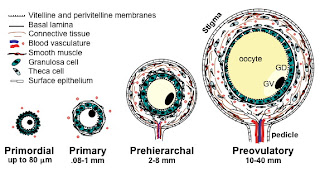 Abstract
Background: Effects of androgens on follicle maturation have been controversial for some time.
Here, we review the potential of their applications in improving human ovulation induction, based on human and animal data, reported in the literature.
Discussion: Selective androgens appear capable of improving early stages of folliculogenesis.
They, therefore, may represent forerunners of a completely new class of ovulation-inducing medications, which, in contrast to gonadotropins, affect follicle maturation at much earlier stages.
Read rest of article
TODAY'S BOOK SUGGESTION
 Making Babies the Hard Way: Living with Infertility and Treatment
by Caroline Gallup
-- A frank account of one couple's discovery that they cannot have children of their own, and their ensuing struggle through four years of fertility treatment.
One in six couples worldwide seek assistance to conceive and 80 per cent of couples undergoing fertility treatment are currently unsuccessful.
Writing with humour and honesty, Caroline Gallup describes the social, emotional, spiritual and physical impact of infertility on her and her husband, Bruce, including feelings of bereavement for the absent child, the unavoidable sense of inadequacy and the day-to-day difficulties of financial pressure.
As well as telling her own moving story, she also offers information and guidance for others who are infertile, or who are considering or undergoing treatment.
Paperback: 240 pagesClick to order/for more info: Making Babies the Hard Way
Find it on Amazon: US | CDN | UK
Start reading Making Babies the Hard Way on your Kindle in under a minute!Don't have a Kindle? Get your Kindle here, or download a FREE Kindle Reading App.
 February 2, 2010 — The European Commission (EC) has approved corifollitropin alfa subcutaneous injection (Elonva, Merck and Company, Inc), the first sustained follicle stimulant.
Corifollitropin is indicated for controlled ovarian stimulation (COS) in combination with a gonadotropin-releasing hormone antagonist for the development of multiple follicles in women participating in an assisted reproductive technology program.
Read more...
Life Begins... - Miscarriage stories of loss, hope & help
Pregnancy Stories by Age - Daily blog of hope & inspiration!
Stories of Pregnancy over 44 years old - sharing stories I find online, for inspiration!
Pregnancy Stories by Age - Daily blog of hope & inspiration!
Stories of Pregnancy over 44 years old - sharing stories I find online, for inspiration!
Recent Keyword Searches: think twice before touching fertility statues, can women over 40 get pregnant, examples of 49 year old women becoming pregnant, can you get pregnant with high fsh levels?, woman 49 pregnant with own eggs
 Scientists at Virginia Commonwealth University have identified a gene, which they assert causes infertility. They said that, such types of genes send molecular signals used for the ovarian follicle development. This may be a guiding source for learning the fertility related issues in humans.
The scientists used a mouse model to examine the role of Smad-3 in the early stages of follicular growth.
They on careful observation found that, follicle-stimulating hormone, or FSH needs a particular gene to function in the body. So they confirmed that, the mice didn’t experience normal ovulation due to the absence of such gene.
Further, the researchers concluded that Smad-3 is an important class of proteins that are essential for follicle development.
"Learning precisely how the FSH receptor is regulated is an important step in understanding the subtle defects in signal transduction that can interfere with follicle development and female fertility and could lead to new types of fertility treatments," Prof Elizabeth McGee said.
These findings have been published in the current issue of 'Biology of Reproduction' journal.
Source
Life Begins... - Miscarriage stories of loss, hope & help
Pregnancy Stories by Age - Daily blog of hope & inspiration!
Stories of Pregnancy over 44 years old - sharing stories I find online, for inspiration!
Pregnancy Stories by Age - Daily blog of hope & inspiration!
Stories of Pregnancy over 44 years old - sharing stories I find online, for inspiration!
Recent Keyword Searches: until what age women can conceive naturally, can a 44 year old get pregnant, is it less likely to get pregnant at 43 years old, having kids after 40, pregnact at 40
 For the first time, scientists have managed to grow mature human eggs from immature cells in the lab, a technique that may eventually help save the fertility of female cancer patients who aren’t eligible for traditional egg harvest.
Researchers from Northwestern University took immature egg cells, encased in a protective sac called a follicle, from 14 women who wanted to preserve their fertility before undergoing chemotherapy. By placing the cells in a unique three-dimensional growing environment for 30 days, the scientists coaxed the cells into becoming what appear to be healthy, functional human eggs.
“It is a major first,” said infertility expert Sherman Silber of St. Luke’s Hospital in St. Louis, who was not involved in the research. “No one has yet tested the eggs by in-vitro fertilization and pregnancy, but they look quite normal and we are all excited about it.”
Read more: http://www.wired.com/wiredscience/2009/07/humanegg/
Life Begins... - Miscarriage stories of loss, hope & help
Pregnancy Stories by Age - Daily blog of hope & inspiration!
Stories of Pregnancy over 44 years old - sharing stories I find online, for inspiration!
Pregnancy Stories by Age - Daily blog of hope & inspiration!
Stories of Pregnancy over 44 years old - sharing stories I find online, for inspiration!
Recent Keyword Searches: how to get pregnant in your 40's, getting pregnant over 40 years old, percentage women over 40 who eventually get pregnant, can i get pregnant at 47 year, can you get pregnant in your 40's
Photo by host1.bondware.com
 In the May 5, 2005, issue of Reproductive Biology and Endocrinology, the discovery that new human eggs can be developed in vitro from cells scraped from the surface of adult human ovaries was made in the laboratory of Dr. Antonin Bukovsky, MD, PhD.
These results suggest that cells scraped from the ovary could be a potential source of new eggs for women who have trouble conceiving — either due to age or other complications such as a lack of ovarian follicles, the structures composed of an egg surrounded by granulosa cells.
For women who want to delay having babies, these results suggest the possibility of having ovarian surface epithelium (OSE) cells frozen in order to produce new eggs at a later date.
Full story: http://host1.bondware.com/~knoxvillemed/news.php?viewStory=151
Life Begins...
Miscarriage stories of loss, hope & help
http://born2luv.blogspot.com/
Stories of Pregnancy & Birth over 44y
- Daily blog of hope & inspiration!
http://pregnancyover44y.blogspot.com/
4,750 Stories of Pregnancy & Birth over 44y
Daily blog of hope & inspiration!
http://pregnancyover44y.blogspot.com/
Recent Keyword Searches: how can i improve my egg quality, why don't women in there forties get pregnant?, is it easy to get pregnant in your forties, do our chances of conceiving drop after trying for 12 months?, children of older parents
In the May 5, 2005, issue of Reproductive Biology and Endocrinology, the discovery that new human eggs can be developed in vitro from cells scraped from the surface of adult human ovaries was made in the laboratory of Dr. Antonin Bukovsky, MD, PhD.These results suggest that cells scraped from the ovary could be a potential source of new eggs for women who have trouble conceiving — either due to age or other complications such as a lack of ovarian follicles, the structures composed of an egg surrounded by granulosa cells.
For women who want to delay having babies, these results suggest the possibility of having ovarian surface epithelium (OSE) cells frozen in order to produce new eggs at a later date.
Full story: http://host1.bondware.com/~knoxvillemed/news.php?viewStory=151
Life Begins...
Miscarriage stories of loss, hope & help
http://born2luv.blogspot.com/
Stories of Pregnancy & Birth over 44y
- Daily blog of hope & inspiration!
http://pregnancyover44y.blogspot.com/
4,750 Stories of Pregnancy & Birth over 44y
Daily blog of hope & inspiration!
http://pregnancyover44y.blogspot.com/
Recent Keyword Searches: how can i improve my egg quality, why don't women in there forties get pregnant?, is it easy to get pregnant in your forties, do our chances of conceiving drop after trying for 12 months?, children of older parents
Photo by www.dailymail.co.uk
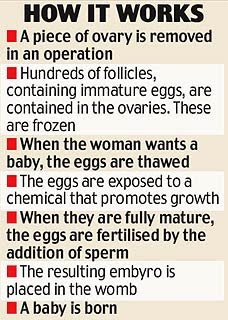 A major breakthrough by British scientists could bring new hope for women facing the heartbreak of infertility.
For the first time a team has managed to grow hundreds of eggs in the laboratory using a new technique which could help cancer patients whose treatment can leave them infertile.
It would also allow thousands more women to wait until middle age to have children.
The scientists from Edinburgh University have shown that immature eggs can be frozen, grown and matured in the lab.
The process could lead to women having pieces of ovary containing the immature eggs removed and stored. Much later on, they could be thawed, fertilised and finally implanted into the womb.
The breakthrough, which comes as MPs prepare to debate the controversial Human Fertilisation and Embryology Bill, raises again the ethical debate surrounding the freezing of eggs.
Some say it is morally wrong for a woman to do so and have them fertilised years later in order to delay having children while she pursues a career.
However, scientists hope the new process will revolutionise fertility preservation for women because it will allow them to store many more eggs than they can under traditional IVF techniques.
And, because immature eggs survive the freezing process much better than the mature ones used in IVF, it is much more likely that older women will be able to conceive using them.
It brings forward the prospect that thousands of women will use the technique to side-step the menopause, delaying motherhood for the sake of their careers.
The process, which could be available in five years, also provides hope for cancer sufferers who at the moment are often left infertile following chemotherapy and radiotherapy.
Powerful anti-cancer drugs can destroy follicles in the ovaries, wiping out any possibility of women having children.
At the moment, these women have a piece of ovary removed, frozen and then re-transplanted after their cancer treatment. But there is always the danger that the cancer could be reintroduced by the implant.
The new technique means women's immature eggs contained in the patch of ovary could be grown in the lab and then screened for cancer before being used in IVF treatment.
There are also hopes it will provide a rich source of eggs for scientists to study for clues on ways to treat a range of diseases.
There is a shortage of human eggs for medical research, and if the technique works it would bypass the controversy over the use of animal-human 'hybrid' embryos.
The Human Fertilisation and Embryology Bill, which MPs are due to debate next month, would allow scientists to use these embryos in medical research, but many MPs plan to vote against.
The research, carried out by an Edinburgh University team led by Dr Evelyn Telfer, is published today in the journal Human Reproduction.
"This is a significant step in developing immature eggs to maturity outside the body," said Dr Telfer.
"Women who face infertility as a result of chemotherapy, or who want to put their biological clock on hold, could benefit from this system.
"However, there is a lot more research to be carried out before this technique could be safely applied within a clinical setting."
Last year, Canadian scientists announced the first birth of a child created from a human egg matured in the laboratory.
However, they did not use the same "primordial follicles" studied by the researchers from Edinburgh.
These are the tiny egg-bearing pockets within the ovaries that are present in their millions at birth, but gradually die off over the course of a woman's life.
They represent a woman's fertility "battery" which once depleted cannot be recharged.
Many remain dormant, but some go on to mature and eventually release their eggs in preparation for fertilisation.
For the first time, the team led by Dr Telfer has succeeded in growing primordial follicles to a late stage of maturation in the lab.
They took pieces of ovary containing the follicles from six volunteer women who were giving birth by caesarean section.
These were then exposed to a chemical that promotes growth, similar to the one that functions in the ovaries.
Around a third of them survived and went on to reach the advanced 'antral' stage of development.
At this stage, the follicles are filled with fluid and contain eggs almost ready to be fertilised.
It means that it could soon be possible to grow hundreds of eggs in the laboratory.
The Canadian team which managed to create a child from immature eggs was working with only around a dozen.
Another advantage is that the follicles mature much more quickly in the lab than they do in the ovary.
The scientists do not yet know whether eggs - or oocytes, to give them their technical name - matured in this way are completely normal and suitable for in-vitro fertilisation. But animal studies suggest they are.
The next step is to use hormones and other substances to try to nudge the 'antral' eggs on to the next stage of maturation, and then test the technique on humans.
"We believe there's good evidence that we can get normal oocytes, but of course you would never apply this technique clinically until you are sure," said Dr Telfer.
"We're seeking funding for further research to bridge that gap. It might take five to ten years from now before we get to the stage of a clinical trial."
Dr Jane Stewart, consultant in reproductive medicine at the Newcastle Fertility Centre, said:
"This work increases our understanding of the maturation of human eggs in the lab and takes us a step nearer the goal of strong immature eggs for fertility preservation for women."
Source: http://www.dailymail.co.uk/pages/live/articles/health/healthmain.html?in_article_id=560951&in_page_id=1774
Life Begins...
Miscarriage stories of loss, hope & help
http://born2luv.blogspot.com/
Stories of Pregnancy & Birth over 44y
- Daily blog of hope & inspiration!
http://pregnancyover44y.blogspot.com/
4,600 Stories of Pregnancy & Birth over 44y
Daily blog of hope & inspiration!
http://pregnancyover44y.blogspot.com/
 A major breakthrough by British scientists could bring new hope for women facing the heartbreak of infertility.
For the first time a team has managed to grow hundreds of eggs in the laboratory using a new technique which could help cancer patients whose treatment can leave them infertile.
It would also allow thousands more women to wait until middle age to have children.
The scientists from Edinburgh University have shown that immature eggs can be frozen, grown and matured in the lab.
The process could lead to women having pieces of ovary containing the immature eggs removed and stored. Much later on, they could be thawed, fertilised and finally implanted into the womb.
The breakthrough, which comes as MPs prepare to debate the controversial Human Fertilisation and Embryology Bill, raises again the ethical debate surrounding the freezing of eggs.
Some say it is morally wrong for a woman to do so and have them fertilised years later in order to delay having children while she pursues a career.
However, scientists hope the new process will revolutionise fertility preservation for women because it will allow them to store many more eggs than they can under traditional IVF techniques.
And, because immature eggs survive the freezing process much better than the mature ones used in IVF, it is much more likely that older women will be able to conceive using them.
It brings forward the prospect that thousands of women will use the technique to side-step the menopause, delaying motherhood for the sake of their careers.
The process, which could be available in five years, also provides hope for cancer sufferers who at the moment are often left infertile following chemotherapy and radiotherapy.
Powerful anti-cancer drugs can destroy follicles in the ovaries, wiping out any possibility of women having children.
At the moment, these women have a piece of ovary removed, frozen and then re-transplanted after their cancer treatment. But there is always the danger that the cancer could be reintroduced by the implant.
The new technique means women's immature eggs contained in the patch of ovary could be grown in the lab and then screened for cancer before being used in IVF treatment.
There are also hopes it will provide a rich source of eggs for scientists to study for clues on ways to treat a range of diseases.
There is a shortage of human eggs for medical research, and if the technique works it would bypass the controversy over the use of animal-human 'hybrid' embryos.
The Human Fertilisation and Embryology Bill, which MPs are due to debate next month, would allow scientists to use these embryos in medical research, but many MPs plan to vote against.
The research, carried out by an Edinburgh University team led by Dr Evelyn Telfer, is published today in the journal Human Reproduction.
"This is a significant step in developing immature eggs to maturity outside the body," said Dr Telfer.
"Women who face infertility as a result of chemotherapy, or who want to put their biological clock on hold, could benefit from this system.
"However, there is a lot more research to be carried out before this technique could be safely applied within a clinical setting."
Last year, Canadian scientists announced the first birth of a child created from a human egg matured in the laboratory.
However, they did not use the same "primordial follicles" studied by the researchers from Edinburgh.
These are the tiny egg-bearing pockets within the ovaries that are present in their millions at birth, but gradually die off over the course of a woman's life.
They represent a woman's fertility "battery" which once depleted cannot be recharged.
Many remain dormant, but some go on to mature and eventually release their eggs in preparation for fertilisation.
For the first time, the team led by Dr Telfer has succeeded in growing primordial follicles to a late stage of maturation in the lab.
They took pieces of ovary containing the follicles from six volunteer women who were giving birth by caesarean section.
These were then exposed to a chemical that promotes growth, similar to the one that functions in the ovaries.
Around a third of them survived and went on to reach the advanced 'antral' stage of development.
At this stage, the follicles are filled with fluid and contain eggs almost ready to be fertilised.
It means that it could soon be possible to grow hundreds of eggs in the laboratory.
The Canadian team which managed to create a child from immature eggs was working with only around a dozen.
Another advantage is that the follicles mature much more quickly in the lab than they do in the ovary.
The scientists do not yet know whether eggs - or oocytes, to give them their technical name - matured in this way are completely normal and suitable for in-vitro fertilisation. But animal studies suggest they are.
The next step is to use hormones and other substances to try to nudge the 'antral' eggs on to the next stage of maturation, and then test the technique on humans.
"We believe there's good evidence that we can get normal oocytes, but of course you would never apply this technique clinically until you are sure," said Dr Telfer.
"We're seeking funding for further research to bridge that gap. It might take five to ten years from now before we get to the stage of a clinical trial."
Dr Jane Stewart, consultant in reproductive medicine at the Newcastle Fertility Centre, said:
"This work increases our understanding of the maturation of human eggs in the lab and takes us a step nearer the goal of strong immature eggs for fertility preservation for women."
Source: http://www.dailymail.co.uk/pages/live/articles/health/healthmain.html?in_article_id=560951&in_page_id=1774
Life Begins...
Miscarriage stories of loss, hope & help
http://born2luv.blogspot.com/
Stories of Pregnancy & Birth over 44y
- Daily blog of hope & inspiration!
http://pregnancyover44y.blogspot.com/
4,600 Stories of Pregnancy & Birth over 44y
Daily blog of hope & inspiration!
http://pregnancyover44y.blogspot.com/
Photo by stylesr1
 London, April 21 (ANI): Scot scientists have achieved a breakthrough in taking early stage follicles tiny egg-bearing pockets in the ovaries from a woman’s ovaries, and maturing them into eggs in the lab for the first time.
The achievement of Edinburgh University researchers means that women undergoing cancer treatment, or wishing to delay motherhood to concentrate on their careers, may have a way of preserving their fertility in the next five to 10 years.
Dr Evelyn Telfer and her colleagues say that they have established a procedure to develop early stage follicles to a much later stage.
The researchers took pieces of ovary containing the follicles from six volunteer women who were giving birth by elective caesarean section, and exposed them to an artificial growth factor.
They revealed that about one-third of the follicles survived, and went on to reach an advanced stage.
“This is a significant step in developing immature eggs to maturity outside the body. Women who face infertility as a result of chemotherapy, or who want to put their biological clock on hold, could benefit from this system, the Scotsman quoted Dr. Telfer as saying.
“However, there is a lot more research to be carried out before this technique could be safely applied within a clinical setting,” she added.
Normally, a woman undergoing cancer treatment has to have a piece of ovary removed and frozen for future transplantation, a procedure that carries the risk of reintroducing cancer cells to the patient.
They may also rely on fertility medication to produce eggs to be harvested for use at a later date, but this poses risks in delaying treatment, and defrosting the eggs does not always work.
Dr Telfer says that one alternative may be to maturing eggs in the laboratory may make it possible to screen them for cancer before they are returned.
In a report published in the journal Human Reproduction, the researcher says that women wishing to preserve their fertility past the menopause may also have their follicles stored for later use when they are ready to start a family.
She has revealed that in animal studies, eggs matured in this way appear to be completely normal and suitable for in vitro fertilisation.
However, her team have yet to confirm the same for humans.
“We believe there’s good evidence that we can get normal oocytes (eggs], but of course you would never apply this technique clinically until you are sure,” said Dr Telfer. (ANI)
Source: http://www.thaindian.com/newsportal/india-news/breakthrough-may-preserve-fertility-post-menopause_10040356.html
Life Begins...
Miscarriage stories of loss, hope & help
http://born2luv.blogspot.com/
Stories of Pregnancy & Birth over 44y
- Daily blog of hope & inspiration!
http://pregnancyover44y.blogspot.com/
4,550 Stories of Pregnancy & Birth over 44y
Daily blog of hope & inspiration!
http://pregnancyover44y.blogspot.com/
Recent Keyword Searches: fertility at 40, soft ivf, in vitro donor egg forty, 34 and pregnant is that too old?, normal periods over 44 can i get pregnant, should i go abroad for doner eggs to get pregnant at 42, how to get pregnant after age 40, can a 51 year old woman get pregnant, best way to get pregnant at the age of 40, natural ways to get pregnant at 40
 London, April 21 (ANI): Scot scientists have achieved a breakthrough in taking early stage follicles tiny egg-bearing pockets in the ovaries from a woman’s ovaries, and maturing them into eggs in the lab for the first time.
The achievement of Edinburgh University researchers means that women undergoing cancer treatment, or wishing to delay motherhood to concentrate on their careers, may have a way of preserving their fertility in the next five to 10 years.
Dr Evelyn Telfer and her colleagues say that they have established a procedure to develop early stage follicles to a much later stage.
The researchers took pieces of ovary containing the follicles from six volunteer women who were giving birth by elective caesarean section, and exposed them to an artificial growth factor.
They revealed that about one-third of the follicles survived, and went on to reach an advanced stage.
“This is a significant step in developing immature eggs to maturity outside the body. Women who face infertility as a result of chemotherapy, or who want to put their biological clock on hold, could benefit from this system, the Scotsman quoted Dr. Telfer as saying.
“However, there is a lot more research to be carried out before this technique could be safely applied within a clinical setting,” she added.
Normally, a woman undergoing cancer treatment has to have a piece of ovary removed and frozen for future transplantation, a procedure that carries the risk of reintroducing cancer cells to the patient.
They may also rely on fertility medication to produce eggs to be harvested for use at a later date, but this poses risks in delaying treatment, and defrosting the eggs does not always work.
Dr Telfer says that one alternative may be to maturing eggs in the laboratory may make it possible to screen them for cancer before they are returned.
In a report published in the journal Human Reproduction, the researcher says that women wishing to preserve their fertility past the menopause may also have their follicles stored for later use when they are ready to start a family.
She has revealed that in animal studies, eggs matured in this way appear to be completely normal and suitable for in vitro fertilisation.
However, her team have yet to confirm the same for humans.
“We believe there’s good evidence that we can get normal oocytes (eggs], but of course you would never apply this technique clinically until you are sure,” said Dr Telfer. (ANI)
Source: http://www.thaindian.com/newsportal/india-news/breakthrough-may-preserve-fertility-post-menopause_10040356.html
Life Begins...
Miscarriage stories of loss, hope & help
http://born2luv.blogspot.com/
Stories of Pregnancy & Birth over 44y
- Daily blog of hope & inspiration!
http://pregnancyover44y.blogspot.com/
4,550 Stories of Pregnancy & Birth over 44y
Daily blog of hope & inspiration!
http://pregnancyover44y.blogspot.com/
Recent Keyword Searches: fertility at 40, soft ivf, in vitro donor egg forty, 34 and pregnant is that too old?, normal periods over 44 can i get pregnant, should i go abroad for doner eggs to get pregnant at 42, how to get pregnant after age 40, can a 51 year old woman get pregnant, best way to get pregnant at the age of 40, natural ways to get pregnant at 40
Natural cycle as first approach in aged patients with elevated follicle-stimulating hormone undergoing intracytoplasmic sperm injection: A pilot study
Background. Poor ovarian response to standard in vitro fertilization–embryo transfer (IVF-ET) protocols or different regimens of treatment, as consequence of a diminished ovarian reserve, correlates strictly with patient age, elevated follicle stimulating hormone (FSH) and reduced antral follicle count. The aim of the present pilot study was to evaluate the outcome of patients with poor prognostic features undergoing IVF-ET with natural cycles as a first approach and not as a consequence of a previous failure treatment.
Materials and methods. Eighteen aged patients (mean+standard deviation 40.2+0.7 years, range 37–43 years) with elevated serum FSH and reduced antral follicle count underwent intracytoplasmic sperm injection (ICSI) after spontaneous ovulation.
Results. A total of 26 natural cycles with ICSI were analyzed. Pregnancy was observed in three patients, of which two were ongoing as assessed by fetal heart beat at ultrasound scan performed 4–5 weeks after ET.
Conclusion. The overall pregnancy rates achieved (11.5% per cycle, 20.0% per ET) are comparable with those of conventional IVF-ET in aged patients, and not impaired by a single embryo transferred. Better embryo quality, as a consequence of natural selection of oocytes, better endometrium receptivity and monthly repeatability of the procedure, can balance the relatively low chance to perform ET.
Keywords: Aged patients, elevated follicle-stimulating hormone, natural cycle, intracytoplasmic sperm injection
Gynecological Endocrinology, July 2006; 22(7): 351–354
Source: http://www.ingentaconnect.com/content/tandf/ge/2006/00000022/00000007/art00001
More scientific articles: http://www.naturalcycle.org/scientific%20papers.htm
Background. Poor ovarian response to standard in vitro fertilization–embryo transfer (IVF-ET) protocols or different regimens of treatment, as consequence of a diminished ovarian reserve, correlates strictly with patient age, elevated follicle stimulating hormone (FSH) and reduced antral follicle count. The aim of the present pilot study was to evaluate the outcome of patients with poor prognostic features undergoing IVF-ET with natural cycles as a first approach and not as a consequence of a previous failure treatment.
Materials and methods. Eighteen aged patients (mean+standard deviation 40.2+0.7 years, range 37–43 years) with elevated serum FSH and reduced antral follicle count underwent intracytoplasmic sperm injection (ICSI) after spontaneous ovulation.
Results. A total of 26 natural cycles with ICSI were analyzed. Pregnancy was observed in three patients, of which two were ongoing as assessed by fetal heart beat at ultrasound scan performed 4–5 weeks after ET.
Conclusion. The overall pregnancy rates achieved (11.5% per cycle, 20.0% per ET) are comparable with those of conventional IVF-ET in aged patients, and not impaired by a single embryo transferred. Better embryo quality, as a consequence of natural selection of oocytes, better endometrium receptivity and monthly repeatability of the procedure, can balance the relatively low chance to perform ET.
Keywords: Aged patients, elevated follicle-stimulating hormone, natural cycle, intracytoplasmic sperm injection
Gynecological Endocrinology, July 2006; 22(7): 351–354
Source: http://www.ingentaconnect.com/content/tandf/ge/2006/00000022/00000007/art00001
More scientific articles: http://www.naturalcycle.org/scientific%20papers.htm
Life Begins...
Miscarriage stories of loss, hope & help
Stories of Pregnancy & Birth over 44y
Daily blog of hope & inspiration!
4,250 Stories of Pregnancy & Birth over 44y
All the stories, divided by age, 1st pregnancy & high FSH!http://pregnancystories.blogspot.com
Recent Keyword Searches: can i become pregnant in my 40's, optimum estrogen level for embryo transfer, can you get pregnant naturally over 35, too high estrogen levels and fet, can you get pregnant if your estrogen is low, pregnant and 40's, bringing into the u.s. a surrogate from india, two miscarriages then baby over 40, anyone get pregnant at 42?, can women with high fsh get pregnant
Recent Keyword Searches: can i become pregnant in my 40's, optimum estrogen level for embryo transfer, can you get pregnant naturally over 35, too high estrogen levels and fet, can you get pregnant if your estrogen is low, pregnant and 40's, bringing into the u.s. a surrogate from india, two miscarriages then baby over 40, anyone get pregnant at 42?, can women with high fsh get pregnant
Offspring had fewer egg follicles, mouse study shows
WEDNESDAY, Nov. 21 (HealthDay News) -- Researchers have identified the chemical pathway by which a mother's smoking before and after pregnancy might reduce her daughter's fertility by as much as two-thirds.
Cigarette smoking during pregnancy has been shown in retrospective studies to affect the fertility of a woman's offspring, but this is the first study to offer an explanation of the biology behind the effect, the Canadian scientists claim.
A team at the Samuel Lunenfeld Research Institute at Mount Sinai Hospital in Toronto investigated the impact of polycyclic aromatic hydrocarbons (PAH), a byproduct of smoking, on mouse fertility.
Researchers injected three groups of female mice with a low-dose mixture of PAH: One group received PAH before conception and again when they were providing milk for their pups; one group received PAH only before conception; and the third group received PAH only during lactation. A fourth control group did not receive PAH but were mated at the same time as the others. The total amount of PAH given to each mouse over the three-week injection cycle was equivalent to 25 packs of cigarettes, according to the researchers. The exposed mice did not have fewer pups in their own litters, but when researchers investigated the number of eggs in their female offspring, they found about 70 percent fewer follicles available to produce eggs.
"Mothers, mice in this case, exposed to PAHs -- environmental pollutants found in cigarette smoke, car exhaust, smoke produced by fossil fuel combustion, as well as in smoked food --before pregnancy and/or during breast-feeding, but not during pregnancy, can cause a reduction in the number of eggs in the ovaries of their female offspring by two-thirds. This limits the window in which the daughter will be able to reproduce," explained lead researcher Dr. Andrea Jurisicova.
Further analysis indicated that the effects of PAHs on the number of follicles in female offspring were mediated through a receptor that affects the expression of a gene that makes a protein that causes cells to die. The researchers then demonstrated similar effects in human ovarian tissue transplanted into immunocompromised mice.
Jurisicova described the process: "Toxic compounds were injected under the skin of mice and were picked up by the bloodstream and carried throughout the body until they reached the ovaries. Once at the ovaries, they passed through the cell membrane and bound to the receptor. When this happens, it activates the receptor, which then enters the cell nucleus. The receptor then finds a specific DNA sequence that turns on the gene, which accumulates and eventually kills the eggs."
"This study now is providing a chemical pathway, which is very nice," said Dr. Norman Edelman, consultant for scientific affairs with the American Lung Association. The new data provides biological support for epidemiological results, such as the previously observed reduction in fertility among daughters of smoking women, he added.
Whether the news will have an impact on a woman's decision to smoke is another question, said Edelman.
"If we do our job right and these results get good press, this data could remind women of what they are doing to their unborn fetuses," Edelman said.
Another expert noted this latest finding adds to a growing body of evidence that shows a strong connection between smoking and fertility.
"I think it is an interesting study, but it doesn't add much new. Other studies have shown similar outcomes. The theory is that smoking could affect the follicles or the fallopian tubes," said Dr. Amos Grunebaum, director of obstetrics at New York Weill Cornell Medical Center, in New York City. "We have known for many years that smoking affects fertility on many levels."
"The key is women should quit smoking before they are thinking of getting pregnant," Grunebaum said.
The Canadian researchers did offer some good news in their report, published in the Dec. 3 edition of the Journal of Clinical Investigation. Injecting resveratrol in the mice who were exposed to PAH prevented the reduction in egg follicles in their offspring. Resveratrol is a naturally occurring antioxidant found in wine and grape skins. However, that reversal of damage does not mean that women who smoke can counter the effects with a nutritional supplement or a glass of red wine, the researchers stressed.
"We have found that oral consumption of resveratrol as a food supplement, at least in mice, is not effective, as levels of resveratrol do not reach sufficient amount in the bloodstream to provide protection," Jurisicova said.
Although the findings do not define the length of time between quitting smoking and healthier fertility in offspring, Jurisicova noted that previous studies have shown that women who smoke have better results with in vitro fertilization one year after they quit smoking. The mice in the current study conceived up to two weeks after their final PAH injection, which is approximately equivalent to three menstrual cycles in women.
The effect of a mother's cigarette smoking is not limited to her female children. A study published in the Jan. 1 issue of the American Journal of Epidemiology suggested that the male offspring of mothers who smoke have lower sperm counts.
There is still more research to be done, Jurisicova noted.
"We hope to continue studying the female offspring to see if they enter the mouse version of menopause earlier than mice whose mothers were not exposed to PAHs," Jurisicova said. "We also hope to study if their reduced fertility passes on to subsequent generations, and if the granddaughters are predisposed to similar problems."
Source: http://www.nlm.nih.gov/medlineplus/news/fullstory_57913.html
WEDNESDAY, Nov. 21 (HealthDay News) -- Researchers have identified the chemical pathway by which a mother's smoking before and after pregnancy might reduce her daughter's fertility by as much as two-thirds.
Cigarette smoking during pregnancy has been shown in retrospective studies to affect the fertility of a woman's offspring, but this is the first study to offer an explanation of the biology behind the effect, the Canadian scientists claim.
A team at the Samuel Lunenfeld Research Institute at Mount Sinai Hospital in Toronto investigated the impact of polycyclic aromatic hydrocarbons (PAH), a byproduct of smoking, on mouse fertility.
Researchers injected three groups of female mice with a low-dose mixture of PAH: One group received PAH before conception and again when they were providing milk for their pups; one group received PAH only before conception; and the third group received PAH only during lactation. A fourth control group did not receive PAH but were mated at the same time as the others. The total amount of PAH given to each mouse over the three-week injection cycle was equivalent to 25 packs of cigarettes, according to the researchers. The exposed mice did not have fewer pups in their own litters, but when researchers investigated the number of eggs in their female offspring, they found about 70 percent fewer follicles available to produce eggs.
"Mothers, mice in this case, exposed to PAHs -- environmental pollutants found in cigarette smoke, car exhaust, smoke produced by fossil fuel combustion, as well as in smoked food --before pregnancy and/or during breast-feeding, but not during pregnancy, can cause a reduction in the number of eggs in the ovaries of their female offspring by two-thirds. This limits the window in which the daughter will be able to reproduce," explained lead researcher Dr. Andrea Jurisicova.
Further analysis indicated that the effects of PAHs on the number of follicles in female offspring were mediated through a receptor that affects the expression of a gene that makes a protein that causes cells to die. The researchers then demonstrated similar effects in human ovarian tissue transplanted into immunocompromised mice.
Jurisicova described the process: "Toxic compounds were injected under the skin of mice and were picked up by the bloodstream and carried throughout the body until they reached the ovaries. Once at the ovaries, they passed through the cell membrane and bound to the receptor. When this happens, it activates the receptor, which then enters the cell nucleus. The receptor then finds a specific DNA sequence that turns on the gene, which accumulates and eventually kills the eggs."
"This study now is providing a chemical pathway, which is very nice," said Dr. Norman Edelman, consultant for scientific affairs with the American Lung Association. The new data provides biological support for epidemiological results, such as the previously observed reduction in fertility among daughters of smoking women, he added.
Whether the news will have an impact on a woman's decision to smoke is another question, said Edelman.
"If we do our job right and these results get good press, this data could remind women of what they are doing to their unborn fetuses," Edelman said.
Another expert noted this latest finding adds to a growing body of evidence that shows a strong connection between smoking and fertility.
"I think it is an interesting study, but it doesn't add much new. Other studies have shown similar outcomes. The theory is that smoking could affect the follicles or the fallopian tubes," said Dr. Amos Grunebaum, director of obstetrics at New York Weill Cornell Medical Center, in New York City. "We have known for many years that smoking affects fertility on many levels."
"The key is women should quit smoking before they are thinking of getting pregnant," Grunebaum said.
The Canadian researchers did offer some good news in their report, published in the Dec. 3 edition of the Journal of Clinical Investigation. Injecting resveratrol in the mice who were exposed to PAH prevented the reduction in egg follicles in their offspring. Resveratrol is a naturally occurring antioxidant found in wine and grape skins. However, that reversal of damage does not mean that women who smoke can counter the effects with a nutritional supplement or a glass of red wine, the researchers stressed.
"We have found that oral consumption of resveratrol as a food supplement, at least in mice, is not effective, as levels of resveratrol do not reach sufficient amount in the bloodstream to provide protection," Jurisicova said.
Although the findings do not define the length of time between quitting smoking and healthier fertility in offspring, Jurisicova noted that previous studies have shown that women who smoke have better results with in vitro fertilization one year after they quit smoking. The mice in the current study conceived up to two weeks after their final PAH injection, which is approximately equivalent to three menstrual cycles in women.
The effect of a mother's cigarette smoking is not limited to her female children. A study published in the Jan. 1 issue of the American Journal of Epidemiology suggested that the male offspring of mothers who smoke have lower sperm counts.
There is still more research to be done, Jurisicova noted.
"We hope to continue studying the female offspring to see if they enter the mouse version of menopause earlier than mice whose mothers were not exposed to PAHs," Jurisicova said. "We also hope to study if their reduced fertility passes on to subsequent generations, and if the granddaughters are predisposed to similar problems."
Source: http://www.nlm.nih.gov/medlineplus/news/fullstory_57913.html
Stories of Pregnancy & Birth over 44y
- Daily blog of hope & inspiration!
4,200 Stories of Pregnancy & Birth over 44y
All the stories, divided by age, 1st pregnancy & high FSH!
"In 2005, there were more than 104,000 births in the United States to women ages 40 through 44, and over 6,500 to women 45 and older. In 2004, there were 1,786 live births to women over 42, using donor eggs."
Technorati Tags:egg, follicles, fertility, smoking, pregnancy, cigarette, breastfeeding, reproduce, reproduction, ovaries, fetus, resveratrol
Generated By Technorati Tag Generator
Popular Posts
-
 Menopause is the time in a woman's life when her reproductive system shuts down and her reproducing days are over... or are they? For s...
 -
 Photo credit: FertileCM.com - All Rights Reserved Cervical Mucus as a Natural Fertility Sign One of the purposes of cervical mucus is t...
 -
 Modern farming practices, your diet, and your lifestyle, may require that you supplement with certain nutrients to optimize fertility. Am...
 -
 A Zen thought ... A true expert is not the one with the most knowledge, but one who causes the most others to have knowledge. Questions, ...
 -
 Fertility Supplement Bundle Vitamin supplements help fertility in women: Taking multivitamins, particularly folic acid, can improve ch...
 -
 Photo credit: Day 183/365 Doing nothing , by Daniel Oines Many women live through painful periods and discomfort, totally oblivious of t...


Recent Comments